Thursday, 11 September 2014

back on the blog ... again

This image shows a Continental Standard Typewriter, a front strike, four bank. This machine dates from around 1935 (production started in 1904). It was photographed by Ciarán Walsh and posted by Ghistlebertus, blog of www.curator.ie to signal the commencement of development work on ' Tríd on Lionsa' or 'Through the Lens,' the title of a TV series on photography in Ireland between 1880-1900 that has been commissioned by the BAI (Broadcasting Authority of Ireland) for TG4. The series is being developed by Ciarán Walsh of www.curator.ie, Niamh Ní Bhaioll of Sibéal Teo and Cathal Watters. Production is scheduled for October / November 2014.


its been a while and its been erratic, the usual blog scenario. However I'm back on the blog and Ghislebertus remains the inspiration for a blog about a new era of imagining, in this case a reflection on the development of social documentary photography in Ireland between 1880 and 1900.


The impetus to blog ... having something to say ... comes from a commission from TG4 for a series on social documentary photography which has just entered the pre-pre-production phase of intensive research and writing: taking apart the history of photography in Ireland - there aren't that many histories of photography in Ireland - and coming up with a blue print for 6 narratives that reveal the unwritten / untold histories of the people through the lenses of 6 photographers who went west in the 1880s and 90s. 

This image shows a blue print of an antique typewriter in which the keyboard has been modified to spell 'Tríd an Lionsa - Photography on TV.'  'Tríd an Lionsa' is the Irish / gaelic for 'Through the Lens' which is the title of a TV series on photography in Ireland between 1880-1900 that has been commissioned by the BAI (Broadcasting Authority of Ireland) for TG4. The series is being developed by Ciarán Walsh of www.curator.ie, Niamh Ní Bhaioll of Sibéal Teo and Cathal Watters. Production is scheduled for October / November 2014. The image was sourced in Tumbler and modified by Ciarán Walsh for Ghislebertus, the blog of www.curator.ie.


Tríd an Lionsa / Through the Lens 
The unwritten history of life in the West of Ireland, 1880-1900.

The BAI (Broadcasting Authority of Ireland) has agreed to fund a six part series for television that will look at the lives of ordinary people in the West of Ireland as seen through the lenses of six photographers

The series is being developed by www.curator.ie and  Sibéal Teo, Dingle in association with TG4. Work on the production begins in October 2014.


Friday, 21 March 2014

On The Edge of Utopia: Feature by Ciarán Walsh, Irish Inependent Weekend Magazine.


Text of Article:

On the Edge of Utopia 

Utopias have a bad history. Describing a housing estate in a small town in Tipperary as Utopian might seem like a bad joke except that the same development was awarded a Gold Medal at the UN backed International Awards for Liveable Communities (Livcom) in December.

Cloughjordan Eco-Village is being developed by Sustainable Projects Ireland Ltd. (SPIL), founded in Dublin in 1999 with the aim of creating a model community as a template for future development.

“Utopianism at its best is about imagining a future that may look very different from the present ... not in an airy fairy way but in a way that robustly begins to plan for such a future” according to Peadar Kirby, one of the first people to move into the estate in 2009.

Cloughjordan is that future. The project was launched in 2000 and has reached the point where it looks and feels like a living community. 53 homes have been constructed on a 67 acre site just off the main street. A further 30 sites have been sold with 50 sites left to sell.

There is a community woodland, a 12 acre farm, a district energy facility, a solar park, research gardens and allotments, a 32 bed eco-hostel and an eco-enterprise unit.

This has taken 15 years and cost over €7,000,000, only a fraction of which has come from the state. This estate was built by a community, some of whom actually built their own homes.

I spent 24 hours in Cloughjordan being shown around by Davie Philip, a relentlessly forthright spokesperson for the project and a passionate advocate for the ‘oneness’ of community.

Cloughjordan (pop.850) is a settler town, Norman first and Cromwellian second. It was a vibrant market town in the 1800s, boosted by the arrival of the railway in 1864. By 2000 it was in decline, it’s importance as a rural transport hub eliminated by changing demographics.

It wears its history like a threadbare greatcoat, its wide streets and uniform terraces exaggerating the sense of a town that has outlived its purpose. The Eco-Village bought a derelict pub and demolished it, punching a hole in the streetscape to give access to a site it purchased in 2005.

It’s not the best preparation for the shocking contrast between the old and the new. The Eco-Village has ripped up the old order, opting for a cluster model that is reminiscent of a clachan.

The shock is as immediate as it is visual. Sharp contrasts in house-type, scale and material are accentuated by the openness of the site. There are no walls or gates. Paths and play-areas take precedence over cars.

It doesn’t look like a housing estate, in fact it doesn’t look like Ireland at all.  The effect is deliberate. “We wanted make an impact and 15 houses made of sticks in a field was not going to influence anyone” Philip tells me.

Architecture isn’t the only thing that separates Cloughjordan old and new.  The Eco-Village represents a very different way of creating a community.

“Cloughjordan is about a bunch of people coming to a location with the intention of creating a community” says Bruce Darrell who has been involved with the project for 8 years. He spent a year and a half building a house with his neighbour and moved in 3 years ago with his wife Morag and daughter Leontien.

“There is no utopianism here, there are no absolutes. This project was set up 15 years ago and it maintains a huge amount of the ethos of the original vision ... but that matters less to some people, who may just see it as a nice place to live.”

Gregg Allen spent ten years managing the development and agrees that the project has become less utopian and more like an estate. But this not your average suburban estate tacked on to a rural town.

It is a self-organising community and everything is done differently. There are around 130 members of the community, 25 of whom are children. Life is regulated by a system of monthly meetings and work groups.

Pat Malone, a man of intense humanity, is responsible for growing food for all of them. “Families pay up front for fresh produce which is placed in a central depot for people to take what they need. There is no distribution or retail system to distort the coast of high quality, organic produce.”

There is a problem, however. The project is about 30 families short of the critical mass needed to sustain this type of food production. The farm doesn't generate an adequate wage and Malone, and his family, depend on income assistance to get by.

“Research shows that it takes a population of about 2,000 to maintain a fully viable and varied local economy" adds Joe Fitzmaurice, the community baker. He produces 1,000 loaves a week, 160 or so go to members and the bakery is viable  because it has a wider market and a distribution network.

The project has been severely effected by the crash of 2007. There are people who want to live here but can’t sell their houses or can’t get mortgages. 25 people have sites but can’t build and 15 more have paid deposits on sites.

The purchase and servicing of the site required a lot of capital, which was raised through the sale of sites to members. 50 sites remain unsold and this is causing all sorts of difficulties.


Conflict management is a key part of the monthly meetings. “Tensions exist in every community” Kirby tells me “and you wouldn’t have a living community if you didn’t have tensions. It’s how you manage them as a community that matters.”

“Other eco-villages have said that the main points of contention are pets, parenting and parking” Julie Lockett adds, laughing, “but they don’t really apply here.” The flashpoints usually involve expectations; people have different ideas of what they want this place to be and these have to be resolved  through negotiation.”

The same sort of pragmatism can be seen in the approach to education. It is a secular community and religion is a personal matter. Access to secular education is a priority but it will have to wait according to Lockett.

“We have set up an eco-village, we’ve organised the build of our own houses, people are getting their businesses up and running ... you can’t radicalise every area of your life simultaneously, there’s not enough hours in the day.”

And there are bigger problems. There is a skewed demographic in the estate because of the dependence on sites sales and the combined cost of building a home, anything between €180,000 and €300,000

Many members simply can’t afford to live there. Social and affordable housing is regarded as a priority and frustration with local and national government is apparent. “SPIL has always been treated by Tipperary County Council as a standard developer” says Allen.

The Liv Com Award may change that and may help to get the population up to a sustainable level. It’s established that this project is not about alternative lifestyles or some kind of futurology.

This is about technology assisted community systems that are being rolled out in major urban centers across the globe and projects like this need a proactive and imaginative approach by local authorities and statutory agencies in partnership with communities, like the one adopted in Vauban/Freiburg on the French/German border.

None of it matters without jobs according to Pa Finucane who owns Django’s Hostel. “You can talk about sustainability ‘til you’re blue in the face but, if you don’t have a livelihood, it’s not sustainable.”

Tourism linked to education is the mainstay of the hostel. Educating people in the benefits of living in a sustainable community is a core activity and an important source of income.

The potential of web-based eco-enterprise is personified by Una Johnston, an event manager who works Stateside mainly.

“I can work from anywhere as long as I’ve got a laptop, broadband and access to a VPN. The fact that there is fibre optic cable underground means that I have got really good quality IT systems. I don’t commute. I work from here.”

Self-starting eco-enterprises got a boost with the opening this week of an enterprise unit (funded by Enterprise Ireland, North Tipperary County Council and Enterprise Board) in which Anthony Kelly and Ben Whelan have created the first ‘Fab Lab’ or digital fabrication laboratory in Ireland.

“This is the last leg of the Eco-Village story; people have places to live, we have the farm and people now have a place to work” says Kelly. Resilience, optimism and determination characterise this community. They will finish this model village, this “beacon” of community living.

Utopia hangs in the balance, however. Will the new Cloughjordan go the way of the old Cloughjordan? Or does this experiment in sustainable living in the heart of rural Ireland offer new ways of maintaining old communities. Only time will tell and time is running out, fast.


Wednesday, 20 November 2013

Timothy H. O'Sullivan (1840 - 1882) Pioneering Irish / American photographer


FRAMING THE WEST


Litle is known is known of O’Sullivan’s biography. He was born in Ireland in 1840 and came to the United States with his parents two years later. His family settled in Staten  Island and he is thought to have learned his trade from the famed portrait photographer Matthew Brady. By the 1860s he was working in Boston with Alexander Gardneer, documenting the cvil war. He spent much of the conflict in the field with the army of the Ptomac, and is best known for his photographs of dead soldiers on the field at Gettysburg.


After the war, he worked as a photographer for two of the most ambitious geographical surveys of the nineteenth century. He traversed the mountain and desert regions of the western United States under the command of Clarence King and Lt. George M. Wheeler for six seasons between 1867 and 1874.


O'Sullivan developed a forthright and rigorous style in response to the landscapes of the American West. He created a body of work that was without precedent in its visual and emotional complexity, while simultaneously meeting the needs of scientific investigation and western expansion.


“I think that the camera itself, its lens and its ground glass, accounts in part for the modern look of some 19th century photographs,including many of O’Sullivan’s. There is an abstracting activity in the use of this tool. One studies light and dark shapes projected on to a flat rectangle upside down and recognises a picture.”

Mark Rudell On O’Sullivan’s photographs of the Colorado River expedition:

“There is a drama in the expression of space, it’s about being able to position yourself  within a larger view of the landscape and then organising the information in a pictorial way that is compelling, we’re seeing the landscape as unified, but also as dissected: how it is built up vertically but also how big it is vertically.”

Terry Totemeyer


Tuesday, 29 October 2013

Briseann an dúchas ... nature will out.


Lucinda Creighton and Peig Sayers take a stance.  

Creighton was expelled from the Fine Gael parliamentary party in July 2013 when she defied the Fine Gael party whip by voting against the Protection of Life During Pregnancy Bill 2013.

Peig Sayers struck fear into the hearts of generations of second level students who had to study her account of life on the Great Blasket Islands. An exhibition of photographs from the the Great Blasket Island opens in Killarney tomorrow (30.10.2013) and, by chance, Peig's portrait has pride of place. It gets the usual reaction. People recall the long shadow she cast over their teenage years and they stress the fact that Peig's Ireland was another country, the perceived miserablism of her account making the distance even greater.

It's tempting to regard both as representing a particular sense of 'Irishness,' socially conservative and regressive, the Ireland of long ago. Peig maybe off the syllabus but her spirit lives on in the stance adopted by Creighton. Briseann and dúchas trí shúilabh an chait or, in English, the cats real character breaks out through its eyes. The English translation doesn't quite work as well but Aesop put it more succinctly when he said that the cat's "Nature will out." 

El Keegan took the photo. She is a  freelance photographer who covers lifestyle and fashion for a range of press titles. Was she thinking of Peig when she composed the photo? Is this a case of projection...  a deeply ingrained idea of what conservative Ireland looks like?  A case of Briseann and dúchas trí shúilabh an chait?


Fairscin Inise / An Island Portrait
Grianghrafanna den Bhlascaod Mhór / Photographs of The Great Blasket Island 1892 -2010
Roinn Ealaíon, Oidhreachta agus Gaeltachta / Department of Arts, Heritage and the Gaeltacht
Cill Áirne / Killarney
Opening 30.10.2013 @ 6.30pm

Sunday, 6 January 2013

Pandaemonium: Is the idea of surveillance by camera or CCTV as old as the idea of photography itself?


Ideas from the  Christmas book pile no. 1:
Is the idea of surveillance by camera or CCTV  as old as the idea of photography itself?


'everything would then take place under the eye of the Police'

Use of the Camera Obscura, 

The Glasgow Mechanics' Magazine, No. XXXII , August 7,1824


The following article is contained Humphrey Jennings' Pandaemonium 1660 - 1886:


An occurrence originated in a Camera Obscura exhibited here during the Fair week, which shows the important use to which this amusing optical apparatus may be applied. A person happened to be examining, with great interest, the various lively and ever shifting figures which were pourtrayed (sic) upon the white tablet during the exhibition, when he beheld, with amazement, the appearance of one man picking another man's pocket. Perfectly aware of the reality of this appearance, he opened the door, and recognising the culprit at a short distance, ran up and seized him in the very act of depredation. It is, perhaps, unnecessary to add, that he was immediately handed over to the Police. From this circumstance, the utility of placing such apparatus in all places of public amusement and exhibitions, must be obvious.


One on every corner: Alfred Werner's camera of 1893 gives an idea of the scale of the camera obscura used in 1824 (photo: Eddie Chandler).

Whether it might be proper to erect it in the streets of a populous city like this, and to place it under the inspection of an officer for the detection of mischief and crime, is a matter worthy of the consideration of the local authorities. Would it not be an eligible plan, indeed to employ the Camera Obscura of the Observatory, (which is not otherwise in use) to take a view of what is passing in the streets in town, and communicate the result, if necessary, to the Police Office, or the Jail, by means of a telegraph? If the Observatory be considered too far off, the apparatus could be fixed up near the top of the Tron or Cross Steeple.  By this  means, the necessity of sending out emissaries to reconnoitre the conduct of the lieges could be superseded, since every thing would then take place, as it were, under the eye of the Police; and, if any impropriety or misconduct were observed, it would only be necessary to send a posse to te particular spot where it happened.


Humphrey Jennings was a British documentary film-maker who died in 1950 when, at the age of just forty-three. He fell from a cliff in Greece when scouting film locations. Jennings was a socialist, a champion of surrealism and one of the founders of Mass Observation. He was also a pioneer of neo-realism, coaxing extraordinary performances from non-professional actors in several of his works. His best known films are Fires Were Started, The Silent Village and A Diary for Timothy.  Lindsay Anderson described Jennings as ‘the only real poet that British cinema has produced’.


Jennings first started the Pandaemonium project in 1938, initially as a series of talks for miners in South Wales when filming The Silent Village. But the anthology was not completed until nearly forty years after his death, in a collaboration between his daughter, Mary-Lou Jennings, and his former Mass Observation colleague, Charles Madge.

The title is taken from Milton's Paradise Lost:

There stood a Hill not far whose griesly top
Belch’d fire and rowling smoak; the rest entire
Shon with a glossie scurff, undoubted sign
That in his womb was hid metallic Ore,
The work of Sulphur. Thither wing’d with speed
A numerous Brigad hasten’d. As when Bands
Of Pioners with Spade and Pickax arm’d
Forerun the Royal Camp, to trench a Field,
Or cast a Rampart. Mammon led them on,
Mammon, the least erected Spirit that fell
From heav’n, for ev’n in heav’n his looks and thoughts
Were always downward bent, admiring more
The riches of Heav’ns pavement, trod’n Gold,
Then aught divine or holy else enjoy’d
In vision beatific: by him first
Men also, and by his suggestion taught,
Ransack’d the Center, and with impious hands
Rifl’d the bowels of thir mother Earth
For Treasures better hid. Soon had his crew
Op’nd into the Hill a spacious wound
And dig’d out ribs of Gold. Let none admire
That riches grow in Hell; that soyle may best
Deserve the precious bane. And here let those
Who boast in mortal things, and wond’ring tell
Of Babel, and the works of Memphian Kings
Learn how thir greatest Monuments of Fame,
And Strength and Art are easily out-done
By Spirits reprobate, and in an hour
What in an age they with incessant toyle
And hands innumerable scarce perform. 

John Milton, Paradise Lost, Book 1, 1667


Tuesday, 24 July 2012

Synged In Aran


"Je suis Synge, pas Singe" is how John Milington Synge introduced himself to a fellow Irishman on Rue D'Assas in Paris. Last Thursday the sun came out and I got singed in Aran. It was a glorious day, summer had happened all of a sudden and I was caught out with lots of rain gear but no sun block.


The scene on Cill Mhuirbhigh beach reminded me of the photograph, taken by Synge, of horses being landed on Inis Oírr, the sharp sunlight glistening on the waves and giving enough exposure to catch the movement  of a horse as it came ashore through the surf. Here is how Synge described it:


The horses have been coming back for the last few days from their summer's grazing in Connemara. They are landed at the sandy beach where the cattle were shipped last year, and I went down early this morning to watch their arrival through the waves. the hooker was anchored at some distance from the shore, but I could see a horse standing at the gunnel surrounded by men shouting and flipping at it with of rope. In a moment it jumped over into the sea, and some men, who were waiting for it in a curagh, caught it by the halter and towed it to within twenty yards of the surf. Then the curagh turned back to the hooker, and the horse was left to make its own way to the land.


This is my version.


Friday, 6 July 2012

Unravelling In Nama-land


Unravelling In Nama-land


Dublin City Centre: heading south on the Luas (tram) from O'Connell St. past the Custom House, the IFSC and the nice square with the National College of Ireland on it to a gap where the streetscape opens unto a series of abandoned building sites sites dominated, on the right, by the skeleton of Anglo Irish Bank's would be headquarters -  and everything changes, utterly. 

Hope, ambition and the aggressive re-modeling of the Dublin docklands dissipates in a wasteland of unfinished, unwanted  building projects that were going re-define innercity living. The 'plaza' that was to the heart of the Point Village is little more than a series of holes with service pipes sticking out of them,  the  glass covered elevator leading underground to Harry's Bar emphasises the extent of the catastrophe that blitzed the place. This is a ghost town full of zombie 'retail units,' the whiff of popcorn from the Odeon adding a surreal element to a space that is neither alive nor dead.

Welcome to NAMA Land.

In the middle of all of this a gallery has popped up like a weed but, like all weeds, it's hardly been noticed despite its bold dash of colour. The inaugural Pop Up Dublin Biennale 2012 has been pitched by Director / Curator Maggie Magee as a as a bundle of visually arresting 'triggers' that might lead us, as global citizens, to reclaim society and a 'space' that needs 're-addressing.' Featuring 55 artists from 20 countries it has "occupied'  a 10,000 sq. foot space generously donated by Point Village Property. 

The obvious ambition withers as the arts establishment, with the exception of Dublin City Council, stays away and the bulk of the attendance is made up of artists and their friends. The biennale itself is underwhelming. Despite the scale of the space, the art is crammed into the 'galleries' and work that looks well in the catalogue suffers badly in reality. Less work, more selectivity (a little bit of weeding maybe?) and better attention to the basics would have made for a better show. 


Ellen Rothenberg (USA), installation with picket signs, "Ecstasy on Arrest," 2008.


Pop ups, I think, aspire to an energising improvisational quality that has a built in challenge to the stuffiness and institutionalisation of establishment events, like the Biennale's alter ego or rival in Dublin Contemporary perhaps.  This should not be confused with lack of organisation or professionalism. Ellen Rothenberg (USA) admires the energy of the event -typically Irish - but was frustrated with the lack of run in time and rehearsal that led to a performance of her piece being abandoned. The "girls" who were to carry the pickets in a faux demonstration just kept on smiling. Not the sort of thing the piece needed.

It could have been interesting. But would anyone, apart from he staff of the Odeon, have noticed? Does anyone hear you scream in NAMA Land? 

Another performance was 'Unravel' which www.curator.ie filmed in its development phase in Aras Éanna on Inis Oírr in the Aran Islands. At some point in the big bang that gave us NAMA Land, someone described Ireland Inc as the "green thread that would unravel the Euro." Olwen Fouere's performance consisted of unravelling a ball of wool, wrapping its slender and deceptively fragile looking strand around trees and lamp posts in the blitzed Point Village  plaza before slowly rolling it up again. 

It was a slow, mesmerising and engrossed performance that was the perfect fit for Nama Land, a kinetic keening that carried within it the hopelessness of binding a wound that won't be bound, the relentless round of rescue deals and market rebuttals and the thin strand of individual hope or dogged perserverence that maintains some sense that this is a process that might, possibly, maybe lead us out of NAMA Land.

It's a funny place, NAMA Land. It takes a while to notice the strange beauty that is a weed.


Tuesday, 5 June 2012

If I were a book what would I be?


The 41st Listowel Writers' Week kicked off with the usual mix of the international and local that defies the challenging times that are in it according to Festival Chairman Sean lyons. Highlights include Patrick deWitt, Germaine Greer, Peter Taylor, Simon Armitage, John Lanchester, Helen Dunmore, Julian Gough, Aifric Campbell, Maureen Gaffney, Mary Kenny, Paul Durcan, Macdara Woods and Terry Lynch amongst others.

The festival has a programme of art exhibitions that complement the literary focus of its main events. Headlining the programme is a project by a group of North Kerry artists called 'Colourful Spirits' that promised 'exciting collaborative and cross disciplinary exhibition will see the artists exploring the links between literature and art." Sadly, this is precisesly what is lacking from a line up that includes Geraldine O’Sullivan, Liam O’Neill, Maurice Quillinan and Maurice Pierse. The emphasis seems to be on accessibility and locality. The ambition that  drives the international end  of literary programme is nowhere in evidence.

In hard times one has to prioritise but the lack of excitement in visual arts terms is not entirely about budgets. A little bit of imagination and curatorial dexterity could easily have delivered a programme that would complement and enhance a festival that is devoted to international literature and yet remains loyal to local traditions. Unfortunately the programme of art exhibitions, as a showcase of contemporary visual arts, comes nowhere near the quality of the literary programme at any level. 

It begs the question the question, if it were a book, what would  it be? 

Lets start with Mills and Boon …

A caveat. 

Maurice Pierse's illustration and graphic novel work offers a little glimpse of what could have been.


Monday, 14 May 2012

A Headhunting We Will Go ...

Brendan Smyth is led from the Four Courts, Dublin after being convicted in 1997 of sexual offences against children.


A Headhunting We Will Go ...


Like the Creature from the Black Lagoon, Brendan Smyth, paedophile and priest, was dragged up from the depths in a weekend that was all about taking heads. The BAI published its report on 'Mission to Prey' at the same time that another documentary placed an Irish cardinal in the crosshairs.

It was the perfect storm in terms of the media and the church and the danse macabre that is Brady's insistence that he does not have a case to answer in respect of the abuse of children by Smyth, taking cover behind procedure and the implicit belief that it this is all part of a media witch hunt that is only interested in seeing the head of an Irish cardinal roll. 

The media - RTE - had shot itself in the foot with poor standards and a rush to judgement. The only heads to roll were those in Donnybrook. Smyth, back from the dead, cast a long shadow but the the cardinal remains in place.

The nature of his defense, that he was only a notary following procedures, has a certain resonance but it  is all the more shocking in that it was enough save him - unlike the children that his action condemned to further abuse by Brendan Smyth.


Image; Helen McGonigle held a photo of herself as a child around the time she was abused by Brendan Smyth in East Greenwich, R.I. (Bill Greene/ Boston Globe Staff)

 And there's more.


Colm O'Gorman has said Cardinal Brady rose through the ranks in the 
Catholic Church while Smyth continued to rape and abuse children. On the other side of the line we learned that Tom Savage, Chairman of the BAI, had left the priesthood after becoming disillusioned in his role as chief apologist for the church. 

Like Brady he had encountered abuse when he was a priest  - an abusing priest reported by him to his bishop had been moved to a parish in England. He was not happy but did he report it to he Gardaí? 

It seems that the head of the Broadcasting Authority in Ireland and the head of the Catholic Church have come around a circle from opposite directions. Both have had to deal with 'A Mission To Prey' and both have to deal with the consequences of paedophile priests who had been given permission to prey on children, tacitly or otherwise.

As for Mary Kenny; yes Mary, lets be unequivocal about the sexual exploitation, serial rape and buggery of children who had been entrusted to these priest paedophiles. The leniency of sentences handed down to priests who 'interefered' with children is a scandal. Smyth's 12 year sentence was, sadly, the exception.


Tuesday, 1 May 2012

The Headhunters

    Breakfast in the Walsh Household


The Headhunters

Irish Independent, Weekend Magazine, Saturday 28 April 2012 
(© Ciaran Walsh, 2012, Word count 1,500)


It takes about two weeks to preserve a brain inside a severed human head. First you remove the head and then you pump preservatives through the carotids, repeating the procedure until the brain is sufficiently hardened to allow work to commence. This is the short version. A detailed and altogether more gruesome description is contained in the Cunningham Memoirs in the library of the The Royal Irish Academy.

The work in question is an investigation into the difference between man (europeans and negroes) and  anthropoid apes (orangs and gibbons). This was happening in Dublin in 1886 in the Anatomy Department of Trinity College Dublin.

Cunningham was professor of Anatomy and Surgery between 1883 and 1903. He was investigating the origin of the human species in the aftermath of an intensely political and religious struggle that ended, sort of, with the triumph of evolutionary theory.

The human head was the focus of a lot of attention. A report from 1906 describes a meeting of the Ethnological Society in York where a table was laden with skulls that the ladies, several of whom were present it was noted, ‘handled with as little trepidation as they would a water melon.’

Size mattered ... enormously. Cranial capacity – brain size - was regarded as one of the main things that separated humans from anthropoid apes. Cunningham was digging deep to find out exactly why. While Cunningham stayed in the lab, others went out into the field. Anatomical evolution represented one part of anthropological investigation. The development of human societies represented another and a lot of time was spent gathering information on other – non white Anglo Saxon – people that the empire had gathered up in the commonwealth, the so-called savages.

Ireland was a special case. How did one explain the presence of a primitive (white) race living in the back yard of the United Kingdom? The answer had to lie in the origin of the species, in this case the Irish peasant in remote communities all along the west coast.  The Victorians began to search for evidence that might explain the existence of the ‘black’ or ‘Africanoid’ Irish.

Justin Carville specialises in the connection between ethnography, photography and the representation of Irishness. He points to the jutting lower jaw of the Irish as the principal evidence used to suggest a link between Irish primitives and, ultimately, anthropoid apes.

Being Victorian, the scientific community needed something more ‘scientific’ in terms of proof. So, like good ethnographers, they set about collecting information on the physical characteristics and customs of the native Irish. Cranial capacity was high on the agenda. Enter the head hunters.


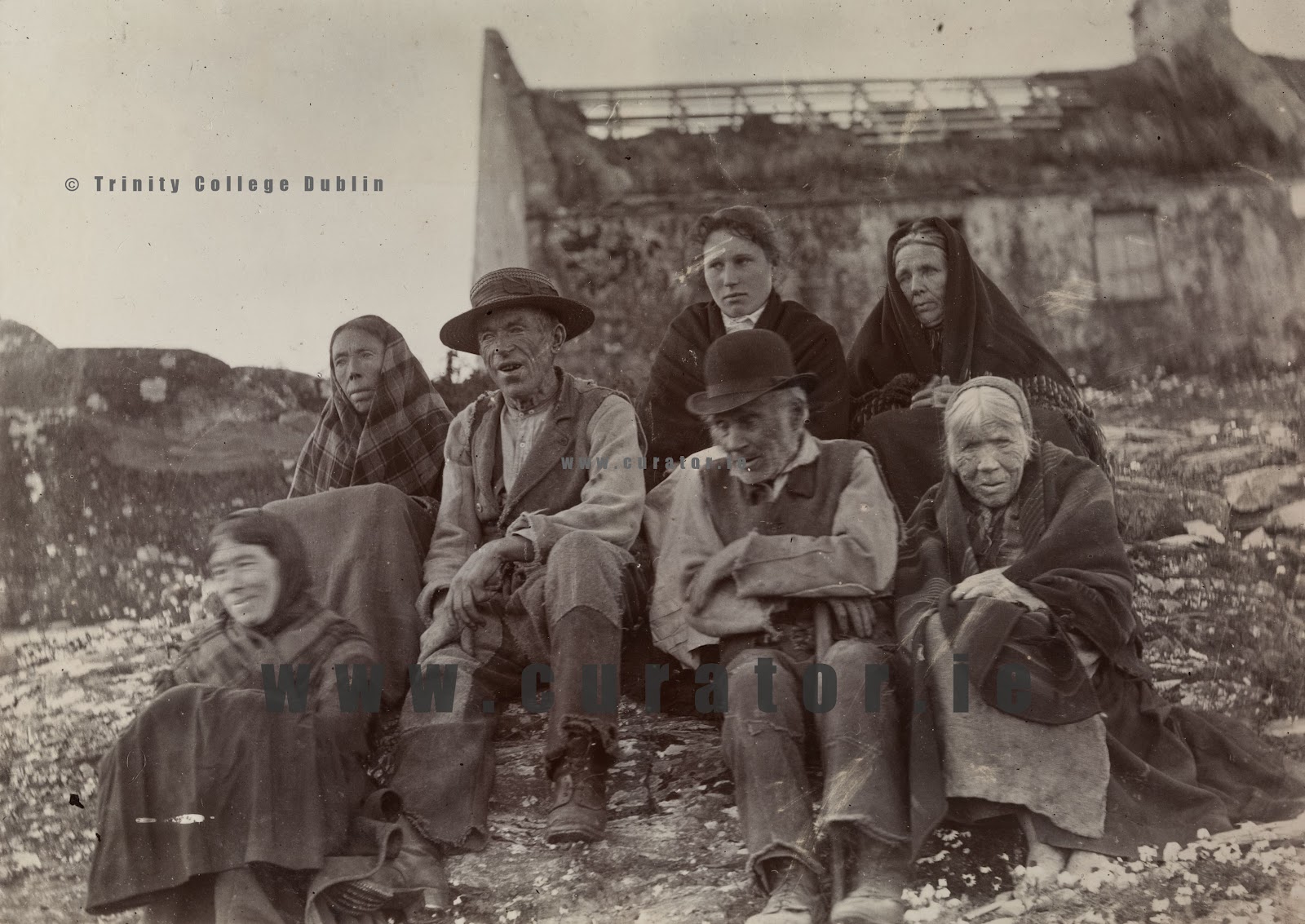
© Trinity College Dublin


Cunningham had a young assistant called Charles R. Browne. He had entered Trinity in 1885 and was studying medicine. They were joined by Alfred Cort Haddon, a zoologist who had developed an interest in ethography following an 1888 expedition to the Torres Strait Islands just north of Australia.

In 1891 they persuaded the Provost and Senior Fellows in Trinity to make part of the Museum of Comparative Anatomy available for an Anthropometry Laboratory. It was equipped with a grant from the Royal Irish Academy. The plan was to transfer the laboratory during the ‘long vacation’ to a carefully selected district in order to carry out an ethnographical survey of the physical characters and habits of the inhabitants as a way of ‘giving assistance to the anthropologist in his endeavours to unravel the tangled skein of the so-called Irish race.’

In 1893 Haddon and Browne ‘pitched their tent’ in Aran and set about recording the  eye colour, skin pigmentation and, of course, cranial capacity of anyone they could get their hands on. The idea that the ‘Aranites’ might be traced to an ancient race of ‘Firbolgs’ had, no doubt, influenced the decision to go there.

The whole thing was photographed, photography being regarded as an essential part of the anthropometrists kit along with the Travellers Anthropometer, the compas d’épaisseur, the compas glissière and the index of Nigressence, a complex formula for determining the ‘blackness’ of a subject.

They took more than measurements and photographs however. When they could they collected the skulls of dead islanders and lodged them in the musuem in Trinity, the collection of specimens being an integral part of the way they worked.

In 1893, Browne recorded that “In addition to the observations made on the living subject , the measurements of a series of crania, the first ever put in the record from this island (Inisbofin) were obtained at St. Colman’s Church, in Knock townland. As they could not be removed at the time of my first visit, I was forced to measure them on the spot, and, as it turned out afterwards, it was well that this precaution had been taken, as, in revisiting the place some time after, I found that they had all disappeared, having in the meantime been removed to some place of concealment.”

Haddon and Browne published a written report of their research – an ethnography – in 1893. This was ground breaking stuff and Haddon was getting noticed. In 1893 he moved back to Cambridge and led an expedition to Torres in 1898. He gained a reputation as a pioneering and influential ethnographer. He also became known as Haddon ‘the Head Hunter.’

Browne remained in Dublin. He set up a general practice in 66 Harcourt St. but continued his involvement in Anthropology in association with Cunningham. He is remembered primarily through his involvement with Haddon in Aran, a mere footnote in the development of Anthropology in Britain.

It is not widely known that Browne continued with his surveys - and his headhunting - throughout the 1890s. In 1889 he reported to the Royal Irish Academy he had surveyed Inishbofin and Inishark, The Mullet, Iniskea, Portacloy, Ballycroy, Clare Island and Inishturk. He went on to survey Garumna and Lettermullen in 1898 and Carna and Mweenish, Connemara in1900.

He carried out a photographic survey of Dun Chaoin in 1897 but no evidence of an ethnography has been found, whether it was written or not. In 1903 funding was sought from the Royal Irish Academy to carry out an ethnographic survey of Donegal but it does not appear to have taken place.

After that Browne disappears from the record. He went to England where he was appointed as a Surgeon Lieutenant of the Gloucestershire Regiment in October 1904. His death in 1931 was recorded by the Royal Irish Academy.

In 1997 a very elderly lady, Browne’s daughter, donated six photographic albums to the Library in Trinity. They contained a remarkable collection of photographs documenting the work of the Anthropometry Laboratory and the ethnographic surveys of the west coast of Ireland.


These photographs had never been published, apart from a small number that were included in the proceedings of the Royal Irish Academy in the 1890s. They are remarkable for two reasons: as a collective portrait of the people of the west coast of Ireland and, as a record of the development of social documentary photography in the 1890s.

In 1895 Browne was in Mayo. He was having difficulty taking photographs in the wind and rain but he still managed to get “17 portraits, 14 of them individuals measured, 12 groups, taken in all parts of the district, 30 illustrations of the occupations, modes of transport, and habitations of the people, also several of the antiquities of the district, and a set of views showing surface of land and nature of coastline, etc.

Some of these photographs were taken by myself, others by my brother J. M. Browne. The  addition of the hand camera to our appliances has proved to be a great advantage, enabling portraits of unwilling subject to be taken, and adding to the value of the photographs of occupations by admitting of their being taken when the performers were in motion. It could also be used when the high winds would not allow the setting up of a tripod stand.”

A selection of these photographs will go on exhibition in association with the Library in Trinity College Dublin and supported financially by the Office of Public Works (OPW) and the Heritage Council. It opens on Thursday 3 May 2012 in the Blasket Centre in Dun Chaoin, West Kerry where it will be on show until the end of June. After that it goes on the road, travelling to Aran, Connemara and the Museum of Country life in Mayo, all the places Browne surveyed.

It is one of the most important photographic archives to come into the public domain in a long time; Browne has named many of the people in the photographs, a fact that sets them apart from every other archive.

And there is more. The ethnographies are full of detailed descriptions of  the lives of the people of the west of Ireland. The devil is in the detail and Browne’s observations are incredibly evocative. He tells us, for instance, that the amount of potatoes and fish in the diet of islanders combined with ‘the abuse of tea’ seemed to result in a lot of flatulence and constipation.


Elsewhere he remarks that ‘The people on the whole are good-looking, especially when young; many of the girls and young women are very handsome, but they appear to age rapidly and early become wrinkled.’ Hardly surprising given that ‘Whatever may be said of the people of other western districts, the people of these islands are not idle or lazy. They could not live if they were, as life is one long struggle to them.” It seems the Irish Headhunter had a heart after all.

‘Charles R. Browne, The Irish Headhunter’ opens in the Blasket Centre, Dún Chaoin west of Dingle on Thursday 3 May 2012. Information available on 066 9156444 or on www.curator.ie.


Photographs Published with the permission of the Board of Trinity College Dublin.


Monday, 27 February 2012

What is Ghislebertus?


www.curator.ie


Ghislebertus?

Ghislebertus is the blog of www.curator.ie the website of Ciarán Walsh, idependent curator, film maker, writer and educator.

Who is Ghislebertus?

No one knows. He inscribed his name on a carving of the day of judgement on the west side of Autun Cathedral sometime in the 12th century; 'Ghislebertus hoc fecit' he wrote which translates from Latin as 'Ghislebertus did this.'

Why Ghislebertus? 

He's the first name in the history of art after the 'Dark Ages,' a maker on the cusp of a new era of imagining. He was a story teller, creating apalling vistas for the illiterate believers of mediaeval Europe in the new medium that was the romanesque cathedral - a massive narrative in stone embellished by Ghislebertus' blog on mortality, salvation and damnation.  

And he is still relevant. As Ireland teeters, one foot in a failed bank and the other in the abyss, the idea of a day of judgement is darkly humorous. But that is not the reason for this blog. Its merely the context.


So, Why Blog?

Let me think about that

www.curator.ie